
Astro Bali Guide
Best Time to See the Milky Way in Bali
Plan your trip around the dry season, the new moon window, and Mount Batur’s dark skies — the perfect recipe for an unforgettable night under the galaxy in Bali.
Quick answer
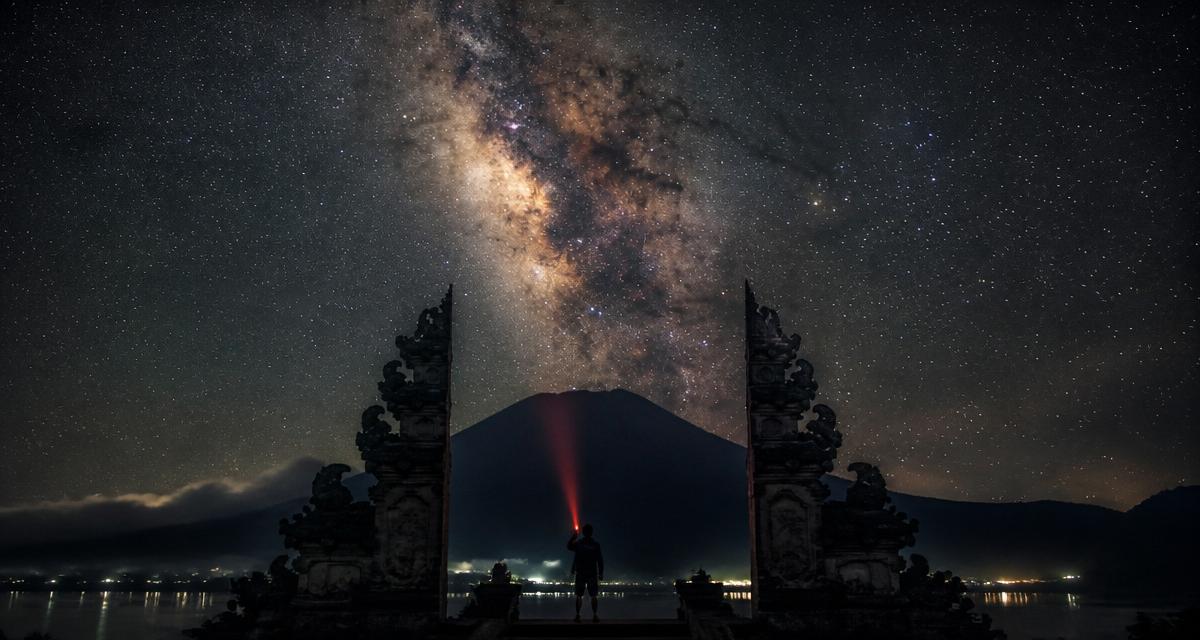
The best time to see the Milky Way in Bali is during the dry season from April to October, especially around the new moon. For the clearest, darkest skies, head inland to high-altitude locations such as Mount Batur in Kintamani, where light pollution is dramatically lower than on the coast.
Why timing matters for Milky Way viewing
The Milky Way is visible to the naked eye only when the sky is dark enough. Three factors control that darkness in Bali: the season, the moon phase, and your distance from artificial light.
Bali sits just 8° south of the equator, which means the Milky Way core is visible overhead for a large part of the year. But the island also has a wet season (November–March) with frequent cloud cover, and a booming tourism coast with bright hotels, beach clubs, and street lighting. Choosing the right date and location makes the difference between a faint haze and a jaw-dropping band of stars.
Best months: Bali’s dry season
The dry season runs from April to October. During these months, humidity drops, trade winds clear the haze, and rain is rare. Statistically, August and September offer the most cloudless nights and the longest dark-sky windows before dawn.
Here is how the months compare for a Bali stargazing trip:
Skies clear after the wet season; Milky Way rises before dawn.
Dry and stable; core is best viewed in the early-morning hours.
Peak conditions: cloudless nights, low humidity, ideal core visibility.
Still mostly dry; transition clouds begin to return late in the month.
The new moon window
Moonlight is the single biggest obstacle to seeing the Milky Way. Even a partial moon can wash out the faint details of the galactic core and the surrounding nebulae. The optimal window is the few nights before, during, and after the new moon, when the moon is not visible at night.
For most travelers, that means planning your Bali stargazing trip for a date within about three days of the new moon. If you are visiting on a full-moon night, you can still enjoy telescopic views of planets and bright star clusters, but the Milky Way band will be much harder to see.
In 2026, the best new-moon windows in the dry season fall in early May, early June, early July, late July, late August, and late September. We plan every private session around these dark-sky windows for maximum viewing quality.
Mount Batur vs. the coast: the Bortle scale
The Bortle scale measures sky darkness from 1 (pristine) to 9 (inner-city). The darker the site, the more of the Milky Way you can see with the naked eye and the more detail a telescope or camera can capture.
Tourist areas like Seminyak, Canggu, and Kuta sit at Bortle class 5–7. Streetlights, beach clubs, and resort lighting brighten the sky and hide the Milky Way core. In contrast, the highlands around Mount Batur in Kintamani reach Bortle class 3–4, with much darker skies and far less light pollution.
| Location | Bortle class | Milky Way visibility |
|---|---|---|
| Mount Batur / Kintamani | 3–4 | Clear naked-eye band + detailed core |
| Ubud outskirts | 4–5 | Faint band; core visible in dark pockets |
| Seminyak / Canggu | 5–7 | Very faint or invisible |
| Kuta / Nusa Dua | 6–8 | Not visible without equipment |
What to expect on a Mount Batur stargazing night
A well-organized Mount Batur stargazing experience starts with a late-afternoon pickup, a jeep ride to a scenic sunset viewpoint, dinner, and then 3+ hours of guided telescope and binocular observation under the stars.
On a dark night you can typically see:
- The Milky Way core with the naked eye
- Saturn’s rings and Jupiter’s moons
- Bright star clusters and nebulae
- Meteors and satellites passing overhead
- Professional astrophotos of you under the stars
Frequently asked questions
What is the best month to see the Milky Way in Bali?
April through October is ideal, with August and September offering the clearest, most stable nights. The Milky Way core is visible for several hours before dawn during these months.
Can you see the Milky Way from Seminyak or Canggu?
It is very difficult. The southern coast of Bali has heavy light pollution (Bortle 5–7), which washes out the faint Milky Way band. For a memorable view, travel to darker inland locations like Mount Batur.
Why does the moon matter for Milky Way viewing?
Moonlight brightens the night sky and reduces contrast, making the Milky Way much harder to see. The darkest skies occur around the new moon, so plan your trip within a few days of that phase.
Ready for your private night under the Milky Way?
Book a private stargazing night with Astro Bali. We time every session around the new moon window and the clearest forecast for the darkest skies and best Milky Way views.